AI: One Word, Many Meanings
AI is not new. Alan Turing asked whether machines can think in 1950, and the field took its name at a Dartmouth workshop in 1956. What is new is that the means have caught up with the idea: since about 2010, the computing used to train AI models has grown far faster than before. One word now covers a tax calculator, a spam filter, a chat assistant and an agent that files an expense claim, and they work in very different ways.
Thesis: AI is not new, but it has only recently been unlocked, and the computing behind it is now growing exponentially. It is many kinds, not one, and each has limits: you need it for some jobs, not all. Pick the right kind for each job, and be ready for it to change faster than anyone can keep up.
Is this the start of Skynet? Maybe, just not in my lifetime. It is a pivotal moment, though. Not Skynet. Probably. (LOL) The part to watch is when AI starts writing parts of itself: in The Self-Authored Agent, an agent wrote the standard it then worked to. Used well, it is valuable: each kind can take a part of the work off your desk while the decisions stay with you. If you build systems, each kind below has its own mechanism, the jobs it fits and its limits.
The Gates Opened
The idea is old. Since Turing asked his question, researchers have tried to build intelligence, some by writing rules and some by copying the brain's networks of neurons in software. For decades the ideas ran ahead of the means: too little computing and too little data to train on. Around 2010 the means began to catch up, and the gates opened. Since then, the computing used to train notable models has climbed exponentially.
Turing proposed his own test in 1950, the imitation game: can a judge chatting by text tell a machine from a person (Turing, 1950)? Seventy-five years later, in a pre-registered study of five-minute chats, judges picked GPT-4.5, prompted to act humanlike, as the human 73% of the time, more often than the real people it was paired against (Jones and Bergen, 2025). Passing the test says the conversation is convincing, not that the system thinks the way we do.
I believe this is the most pivotal change I will see in my lifetime, bigger than the internet and bigger than the phone in your pocket. It will move faster than any of us can keep track of. Done right, it can be amazing. So embrace it, and enjoy the ride.
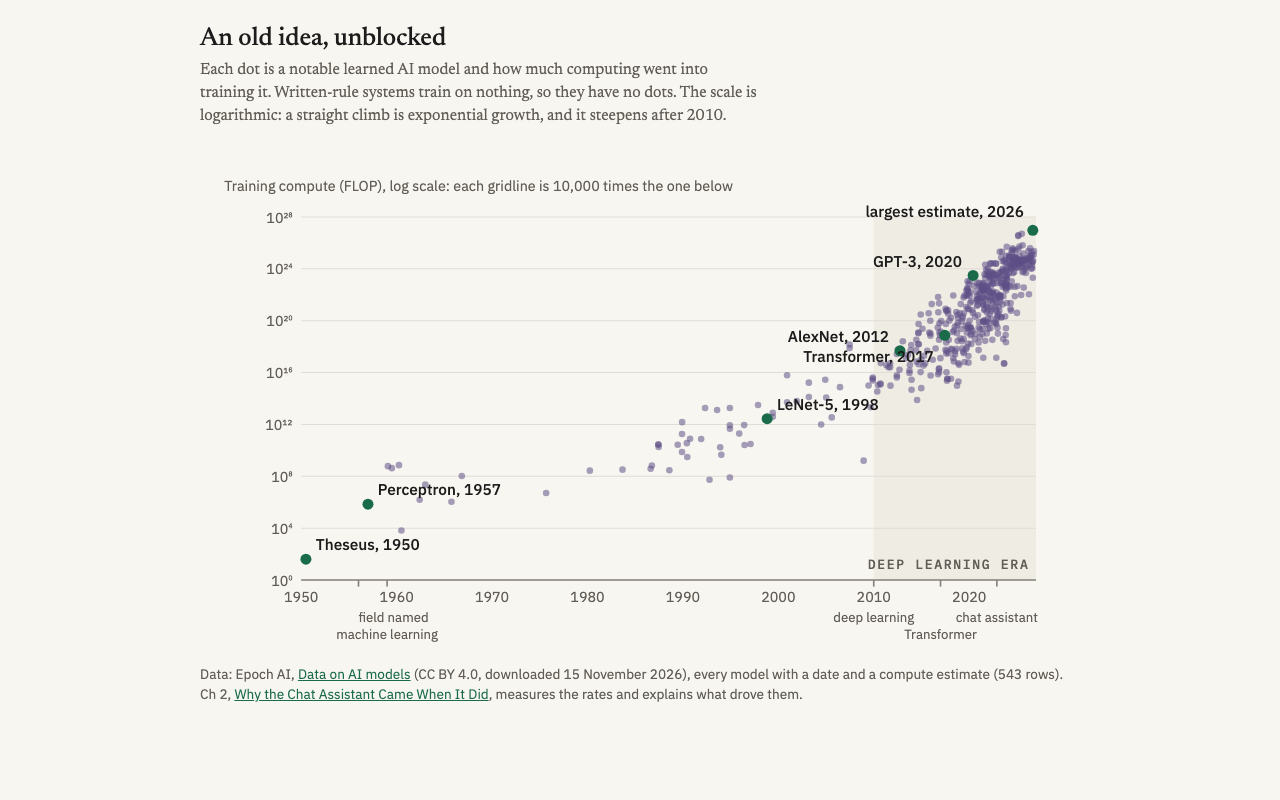
The chart below plots each notable AI model by how much computing went into training it, from Epoch AI's public data, on a logarithmic scale, where a steady climb is exponential growth. The climb steepens after 2010. Why the Chat Assistant Came When It Did measures the rates and explains what drove them.
The walkthrough's steps as text
1. An old idea, unblocked Each dot is a notable AI model, on a log scale. Training compute of notable AI models climbs from 1950 to 2026, slowly at first, then much faster after 2010.
A log-scale chart of training compute for 543 notable AI models from Epoch AI's data, 1950 to 2026. Dots rise from Theseus in 1950 to the largest estimate in 2026, about 25 orders of magnitude, and climb more steeply after 2010. Marks on the time axis show where machine learning, deep learning, the Transformer and the chat assistant began.
How Each Kind Works
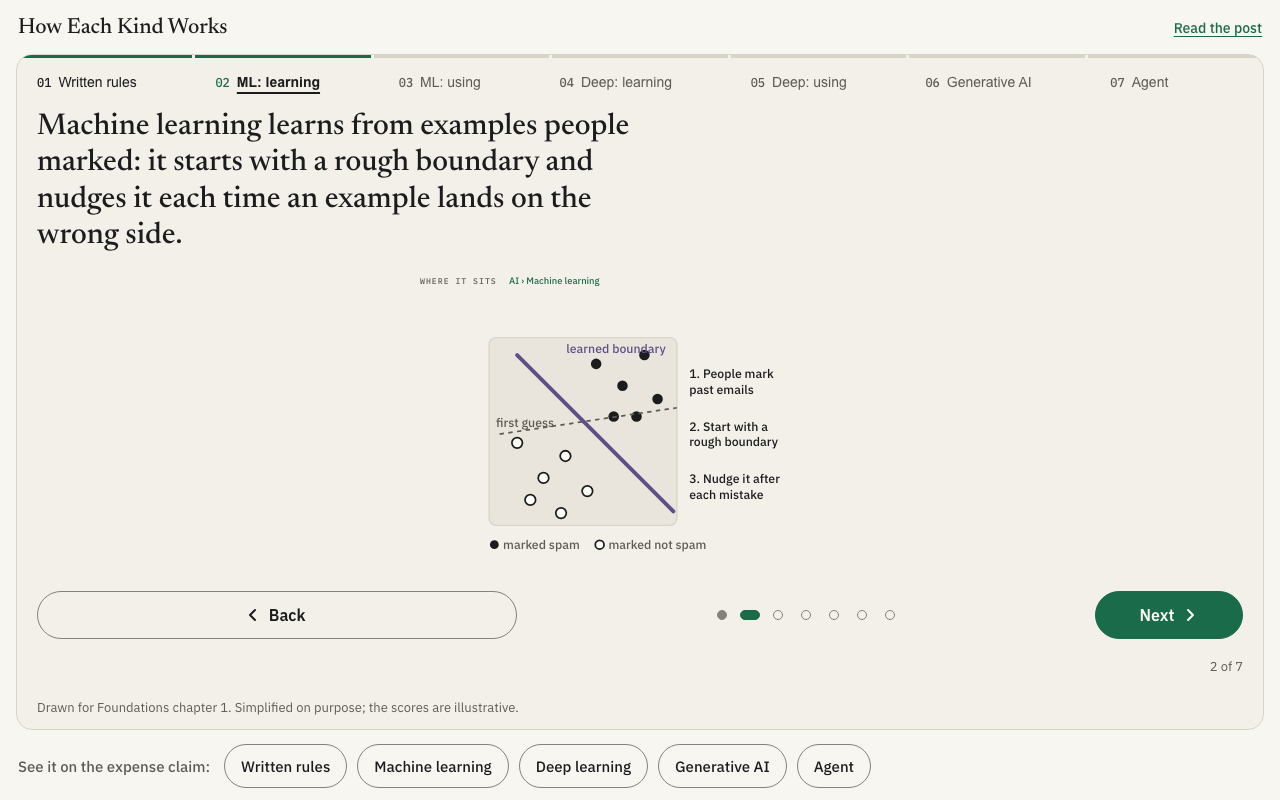
AI is a field of techniques: written rules first, then kinds that learn from examples, each nested inside the last. A plain rules engine is usually just called software today, and the EU's AI Act leaves systems "based on the rules defined solely by natural persons" out of its definition (Recital 12). Like ordinary code, rules are deterministic: the same input always gives the same answer. A generative model is not: ask it twice and it may answer differently. Step through each kind below, how it learns and how it is used.
The walkthrough's steps as text
1. Written rules Where it sits: AI, written rules Written rules are the field’s oldest approach: conditions and calculations people write. Today a plain rules engine is usually just called software.
An income of $50,000 goes into a written rule: if income is over $40,000, rate is 20%; tax is income times rate. Out comes tax of $10,000. Deterministic.
2. ML: learning Where it sits: machine learning Machine learning learns from examples people marked: it starts with a rough boundary and nudges it each time an example lands on the wrong side.
Past emails appear one by one, marked spam (filled) or not (hollow). A rough first-guess line swings into a learned boundary that separates them.
3. ML: using Where it sits: machine learning Once trained, the boundary stays put: each new email is sorted by which side it falls on. Same email, same answer.
The learned boundary is fixed. A new email arrives and lands on the spam side.
4. Deep: learning Where it sits: deep learning, inside machine learning Deep learning trains on thousands of labelled receipts: it guesses the total, checks the label, and adjusts its layers a little whenever it is wrong.
A receipt labelled 12.50 by a person goes into a small network. Its first guess, 9.99, is struck out; the layers adjust and the next guess is 12.50.
5. Deep: using Where it sits: deep learning, inside machine learning Trained, its layers find edges, then shapes, then whole fields, and read a new receipt’s vendor, date and total.
A new receipt passes through a layer of edges and a layer of shapes to three fields: Trattoria, 14 Nov, 640.00.
6. Generative AI Where it sits: generative AI, inside deep learning Generative AI writes by predicting the next token, a word or part of one, over and over. Answers can vary.
The text 'The cat sat on the' with illustrative next-token scores: mat 41%, sofa 22%, floor 15%, other 22%. Mat is picked and added. It learned by predicting the next word in huge amounts of text.
7. Agent An agent is a model in a harness, not a new kind An agent is a model in a loop: it picks a step, the harness runs the tool, and a check decides when it is done.
A loop of four stops: the model picks a step, a tool runs inside the harness, the result comes back, done? If not, round again; if so, stop.
How They Differ, on One Job
The clearest way to see how the kinds differ is to hand them the same job. Take an expense claim: $640 for a client dinner, with a photo of the receipt. Written rules check it against the policy, machine learning scores its risk from past claims, deep learning reads the receipt, and generative AI writes the summary. Each does something the others cannot. An agent ties them together, and a person makes the call.
The walkthrough's steps as text
1. The claim Expense claim 7731 comes in An expense claim arrives: $640 for a client dinner, with a receipt photo. Each kind of AI can take one part of this chore.
An expense claim card: client dinner, $640.00, Thursday 14 November, a note, and a photo of the receipt totalling 640.00.
2. Written rules First kind on the claim: written rules Written rules apply a policy people wrote, the same way every time: over $500 goes to a manager. Best where each decision must be explained.
A policy card of three written rules. Over $500 to a manager matches; receipt attached, yes. Result: to a manager.
3. Machine learning Second kind on the claim: machine learning A model learned from past claims and their outcomes how much each detail matters, and scores this claim. Best where history has known outcomes.
Past claims with their outcomes become learned weights. This claim's amount, category and day add illustrative scores of 0.05, 0.04 and 0.03; the total, 0.12, stays under the review line at 0.5. Result: low risk.
4. Deep learning Third kind on the claim: deep learning A learned model with a deep network inside reads the receipt’s pixels and predicts vendor, date and total. Best for images, speech and messy input.
The receipt becomes pixels that feed layers of a network, which output three fields: vendor Trattoria, date 14 November, total 640.00, matching. Result: read.
5. Generative AI Fourth kind on the claim: generative AI A generative model, the kind behind chat assistants, writes new text token by token: a summary for the manager. Best for drafting; check its facts.
Asked to summarise the claim, the assistant writes: client dinner, $640. Receipt matches; low risk. Approve or query? Result: drafts a summary.
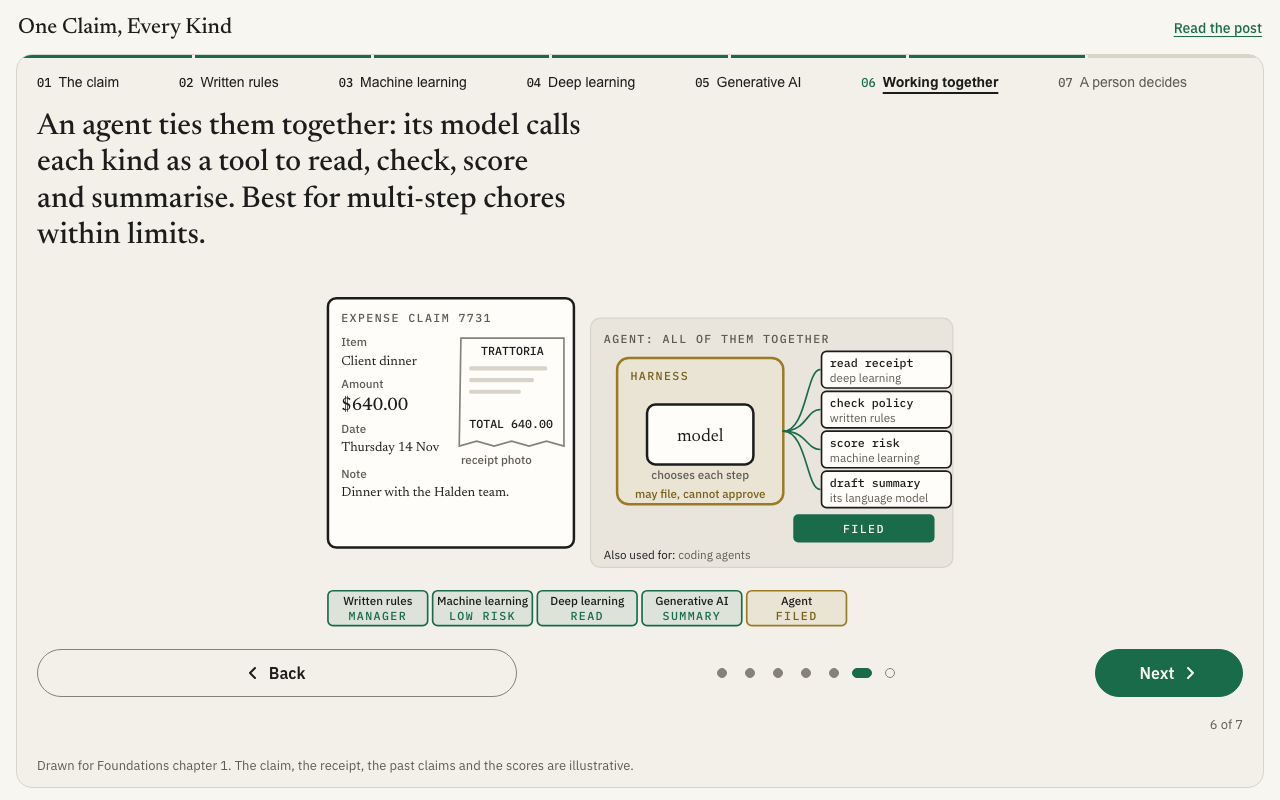
6. Working together An agent calls each kind as a tool An agent ties them together: its model calls each kind as a tool to read, check, score and summarise. Best for multi-step chores within limits.
A model inside a harness calls tools: read receipt with deep learning, check policy with written rules, score risk with machine learning, and drafts the summary with its own language model. It may file but cannot approve. Result: filed.
7. A person decides The manager makes the call on the evidence The manager checks the receipt and the rule that fired, then decides. Each kind did its part; the judgment stays with a person.
The manager's inbox lists the evidence: receipt 640.00, matches; rule fired, over $500 to manager; risk score 0.12, low; summary drafted, check it. An Approve button. Result: decided by a person.
Making It Work for You
In the claim above, every kind took a chore and none took the decision. That is what embracing it well looks like: hand each kind the steps it fits, the repetitive, checkable ones that are safe to undo, and keep a person wherever someone answers for the outcome. Where an Agent Belongs turns that into four questions.
The Right Tool for the Job
You do not need AI for everything, and the newest kind is not always the best one. Start with one question: does the job need the same answer every time? If it does, use deterministic code: written rules, a procedure, a calculation built into ordinary software. A rejection that cites the rule it broke is easy to defend, and a tax bill should never vary. Where there is history with known outcomes, a predictive model fits, and in 2022 a benchmark on medium-sized tables of records found that "tree-based models remain state-of-the-art" (Grinsztajn, Oyallon and Varoquaux, 2022). Where the job is new content, generative AI fits, and its facts still need checking. Each kind has limits; the skill is matching the kind to the job.
What to Do Next
- Name the kind before you judge anything sold as AI: written rules, a model that predicts, one that generates, or an agent around a model.
- Ask if the job needs the same answer every time. If so, use deterministic code; if not, a learned model may fit.
- Keep a person on the decision wherever someone has to answer for it.
- Keep learning. What a kind can do this year, it could not do two years ago.
AI is here, it is growing, and if the trend holds it will keep changing faster than most of us can keep up. Learn the kinds, use each where it fits, and hold on.